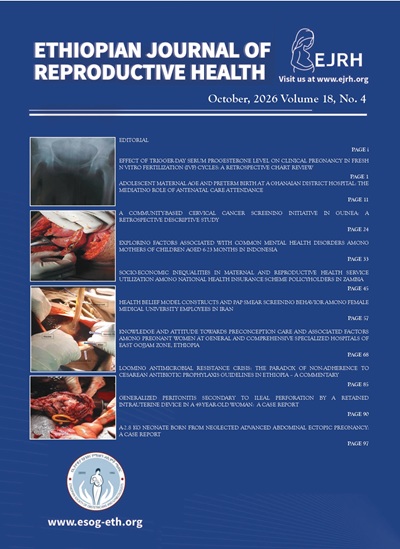
Editorial- Advancing Women’s Health through Evidence and Quality Care
DOI:
https://doi.org/10.69614/ejrh.v18i04.1250Abstract
This issue of the Ethiopian Journal of Reproductive Health includes six original articles, one commentary, and two case reports. The articles cover different aspects of reproductive health, from preventive services and maternal mental health to clinical management and patient safety. Although the studies were conducted in different countries, some of the problems they describe are also familiar to the Ethiopian health system.Prevention is an important theme in this issue. A study from East Gojjam, Ethiopia, found that only 37% of pregnant women had adequate knowledge of preconception care, although their attitudes towards the service were generally favourable. This gap between knowledge and attitude deserves attention. Preconception care provides an opportunity to identify health risks before pregnancy, but women can benefit from it only when the service is available and information reaches them at the right time. The studies from Iran and Guinea also examine challenges in cervical cancer screening. The experience from Guinea is relevant to countries where organised screening programmes are not widely available. However, screening alone is not sufficient; women also need access to diagnostic confirmation, treatment, and follow-up.Access to care is another concern. The study from Zambia examined the use of maternal and reproductive health services among National Health Insurance Scheme policyholders. Education, income, and household characteristics were associated with willingness to contribute to the scheme and use its services. Insurance can help improve access, but financial and social differences may continue to affect who benefits. Efforts to expand health insurance should therefore consider the circumstances of households, particularly those with limited financial resources.Two other studies address issues that are important in clinical practice. The Ethiopian study on progesterone levels on the day of triggering in fresh in vitro fertilisation cycles reported lower clinical pregnancy rates among women with higher progesterone levels. Further prospective studies are needed to establish the clinical implications of this association. In Indonesia, unintended pregnancy and previous pregnancy complications were associated with higher common mental disorder scores among mothers. Maternal mental health deserves attention beyond pregnancy and delivery, including during the period when mothers are caring for their children.The commentary on antibiotic prophylaxis during caesarean delivery raises a practical concern about the difference between recommended practice and what happens in health facilities. Inappropriate use of broad-spectrum antibiotics and unnecessarily prolonged prophylaxis may increase antimicrobial resistance. Preventing surgical site infections requires more than prescribing antibiotics. Access to recommended medicines, proper infection prevention, and adherence to clinical guidelines are equally important.The case reports provide further lessons for clinicians. Ileal perforation associated with a retained intrauterine device is a reminder that rare complications of contraception can have serious consequences. The report of an advanced abdominal pregnancy resulting in a live term neonate also illustrates the difficulties of diagnosis and surgical management in an unusual and potentially life-threatening condition. Such cases are particularly challenging where access to advanced diagnostic and surgical services is limited.The articles in this issue address different problems, but they share a common concern: how to improve the quality and accessibility of reproductive healthcare. Better outcomes will depend not only on the evidence available but also on how well it is applied in practice. Strengthening preventive services, addressing barriers to care, following clinical guidelines, and recognising the wider health needs of women remain important priorities. We hope the studies and clinical experiences presented here will be useful to healthcare professionals, researchers, and policymakers working to improve women's health in Ethiopia and beyond. The Editorial Board thanks the authors and reviewers for their contributions to this issue.
Dr. Wondimu Gudu
Editor-in-Chief,
Ethiopian Journal of Reproductive Health